
BLOG POSTS

WingtraRAY Receives C3 and C6 Certification from EU Drone Port
The WingtraRAY, Wingtra’s VTOL survey and mapping drone, now carries two EU class identification labels: C3 and C6. EU Drone Port, an official Notified Body (Drone Certification Lab) under Delegated Regulation (EU) 2019/945, has issued the EU-type examination certificates (Module B) for the aircraft’s current configuration. This followed a full conformity assessment of its hardware, software, firmware and user documentation.
For survey teams in Europe, this is more than a label on the airframe. C3 covers Open category A3 flights with no operational authorisation at all. C6 makes the WingtraRAY eligible for the European standard scenario STS-02: beyond visual line of sight (BVLOS) flights over a controlled ground area, started with a declaration instead of a full SORA. This article explains what was certified, what each label lets you do in practice, and how to start flying under it.
WingtraRAY at a glance
The WingtraRAY is a tail-sitter VTOL: it takes off and lands vertically like a multirotor, then switches to efficient fixed-wing cruise. Wingtra built it for one job, survey-grade mapping, and the manufacturer’s headline figures reflect that:
- Endurance: up to 59 minutes of flight with the MAP61 sensor.
- Coverage: about 100 ha (250 ac) in 10 minutes at 2.7 cm/px GSD from 120 m.
- Adaptive speed: cruise between 16 and 22 m/s, set automatically to avoid motion blur.
- Accuracy: 3 cm absolute accuracy (RMS x, y, z) with PPK and checkpoint validation.
- Payloads: modular RGB, oblique, multispectral and LiDAR options.
- Safety systems: parachute add-on, redundant hot-swap batteries, obstacle sensing and dual radio plus LTE telemetry.
Wingtra states the WingtraRAY is around 40% faster in the field than its predecessor. That is exactly why a regulatory label matters here: an aircraft that covers this much ground is wasted if every flight is limited to what the pilot can see.
What EU Drone Port certified
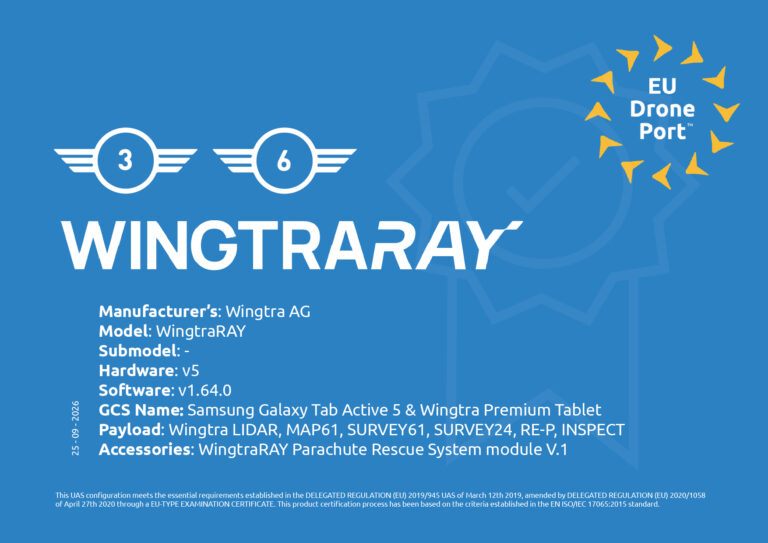
Wingtra AG submitted the WingtraRAY for EU-type examination as a C3 and C6 aircraft, against the essential requirements of Delegated Regulation (EU) 2019/945 as amended by Delegated Regulation (EU) 2020/1058. Our engineers reviewed the technical file and the user manual requirement by requirement. They then tested a production unit indoors and outdoors, covering remote identification, geo-awareness, behaviour on loss of the command and control link, low battery alerts, lights, flight termination and every other function each class requires.
The certificates cover this exact configuration:
| Manufacturer | Wingtra AG (Zurich, Switzerland) |
| Model | WingtraRAY |
| Class labels | C3 and C6 |
| Hardware version | v5 |
| Software version | v1.64.0 |
| Firmware version | v2.22.3 |
| Payload | Wingtra LiDAR, MAP61, SURVEY61, SURVEY24, RE-P, INSPECT |
| Accessories | WingtraRAY Parachute Rescue System module V.1 |
| Procedure | EU-type examination (Module B), DR (EU) 2019/945 |
Configuration matters. A class label applies only to the configuration that was examined, so operators should check that the label on their aircraft and the manufacturer’s EU declaration of conformity match it. This is our second certification for Wingtra, after we certified the WingtraOne Gen II as a C3 drone in 2025.
C3: Open category A3, with no authorisation
With the C3 label, the WingtraRAY flies in subcategory A3 of the Open category under Implementing Regulation (EU) 2019/947. No operational authorisation and no declaration are needed, provided you respect the A3 limits:
- No uninvolved people overflown, and a reasonable expectation that none will be endangered.
- At least 150 m horizontally from residential, commercial, industrial or recreational areas.
- Visual line of sight (VLOS) at all times, and a maximum height of 120 m above the ground.
- The operator is registered, and the remote pilot holds the A1/A3 proof of online training.
This covers everyday work on quarries, mines, agricultural land and rural construction sites. For a refresher on how the categories fit together, see our guide to EU drone regulations from hobby to professional.
C6: STS-02 BVLOS by declaration
C6 is the label that changes the economics. A C6 drone can be flown under STS-02, one of the two European standard scenarios in the Specific category. Instead of preparing a full SORA operational authorisation, the operator submits a declaration to its national aviation authority and can start once receipt is confirmed. With the move from national STS to the European STS-01 and STS-02, this is now the harmonised route across EASA states.
STS-02 in short:
- BVLOS flight over a controlled ground area in a sparsely populated environment.
- Up to 2 km from the remote pilot when airspace observers are used, or up to 1 km without them.
- Maximum height of 120 m, inside a defined flight geography with contingency volume and ground risk buffer.
- An operations manual, a declaration to the authority, and a remote pilot with the STS theoretical certificate plus practical skills training.
The C6 requirements behind this are demanding. They include a flight termination system, programmable flight geography, direct remote identification, a C2 link loss procedure and a maximum speed limit. We cover them in detail in Certification requirements for class C6 drones. On the WingtraRAY, the certified parachute add-on is part of that safety case.
| C3 | C6 | |
|---|---|---|
| Category | Open (A3) | Specific (STS-02) |
| Line of sight | VLOS only | BVLOS, up to 2 km with observers |
| Ground area | 150 m from built-up areas | Controlled ground area, sparsely populated |
| Paperwork | Operator registration | Operations manual and declaration |
| Pilot competency | A1/A3 online training | STS theory certificate and practical skills |
If you already fly a WingtraRAY and want to move into BVLOS, the operations manual is the piece that takes most operators the longest. We write STS-01 and STS-02 manuals ready to submit with your declaration.
What this means for survey and mapping teams
Corridor work is where C6 pays for itself. Roads, railways, pipelines, power lines and river courses are long and narrow, and under VLOS you pack up and relocate every few hundred metres. Under STS-02, a single take-off point can cover several kilometres of corridor. With the WingtraRAY’s endurance, one flight can finish what used to take a morning of short hops.
Large open sites benefit too. Mines, solar farms and agricultural estates often sit in sparsely populated areas where a controlled ground area is realistic to set up, and that is the scenario’s core condition.
A word of realism: STS-02 is not a blank cheque. You still have to control the ground area, respect airspace restrictions and meet any extra conditions your national authority applies. We explain why these vary in Flying your drone in Europe: why national authorities matter.
How to start flying your WingtraRAY under C3 or C6
- Register as a UAS operator in the EASA state where you are established, and display your operator number on the aircraft.
- Check the configuration. Confirm the class label and declaration of conformity match the certified hardware, software, firmware and parachute.
- For C3 flights, make sure every remote pilot holds the A1/A3 certificate.
- For STS-02 flights, get the STS theoretical certificate and complete practical skills training. See what you can do with a European STS drone pilot certificate.
- Write your operations manual and submit the STS-02 declaration to your national authority.
- Check insurance against your national requirements before the first flight.
Our STS course is online and asynchronous, delivered by an Official Designated Training Entity, so your pilots can prepare around field work.
For manufacturers: the route to the EU market
Every class-labelled drone sold in Europe has passed through a Notified Body. EU Drone Port is a Notified Body that works only on UAS, certifying classes C0 to C6, C3 to C5 accessory kits and DRI add-ons. Recent projects include the first drone dock certified as C6 and the Dronelis Cormoran Spray as a C5. You can see where each model stands in our list of EASA certified drones.
If your aircraft is heading for the European market, or you need to re-certify after a hardware or software change, our engineers can scope the assessment with you from the first call.
Frequently Asked Questions
Is the WingtraRAY a C3 or a C6 drone?
Both. EU Drone Port has issued EU-type examination certificates for the WingtraRAY as a C3 and as a C6 unmanned aircraft system under Delegated Regulation (EU) 2019/945. C3 applies to Open category A3 flights, and C6 to the STS-02 standard scenario.
Do I need the parachute to fly the WingtraRAY under C6?
Yes. The C6 configuration includes the parachute add-on, so it must be fitted to operate under STS-02. Without it, the aircraft can still be flown as a C3 drone in subcategory A3.
Can I fly the WingtraRAY BVLOS in Europe without a SORA?
Yes, within the limits of STS-02. You submit a declaration and an operations manual to your national aviation authority instead of applying for a SORA authorisation. Flights must stay over a controlled ground area in a sparsely populated environment, up to 2 km from the pilot with airspace observers.
What pilot qualifications do I need?
For C3 flights in A3, you need the A1/A3 proof of online training. For STS-02 flights with the C6 configuration, you need the STS theoretical knowledge certificate plus practical skills training, as defined in Implementing Regulation (EU) 2019/947.
Is the certification valid in every EU country?
Yes. A class label issued under Delegated Regulation (EU) 2019/945 is recognised in all EASA member states, so the WingtraRAY can be sold and operated under the same rules in all of them. National authorities may still set local airspace restrictions.
Does a software or firmware update affect the certification?
The certificate covers the examined configuration. Any change that could affect compliance with the essential requirements must be assessed by the Notified Body before it is released to certified aircraft. That is why each certificate lists the exact software and firmware versions.